

Your Range Rover has just thrown up a warning light, or your local garage has quoted you a number that made you sit down. You're not alone. Range Rover owners across the UK search for one thing above all else when something goes wrong: a straight answer on what it's actually going to cost.
This guide gives you that answer, not a vague "it depends," but real cost ranges, broken down by model, engine, mileage, and fault, so you know whether you're being quoted fairly before you hand over a card.
Quick answer: most Range Rover repairs in the UK fall between £150 for a diagnostic check and £150–£300 for brake work, rising to £1,500–£4,000+ for air suspension, turbo, or gearbox faults, and £4,000–£9,000+ for a full engine rebuild or replacement. Where you land on that scale depends heavily on the model, the engine, the mileage, and, just as importantly, who you take it to.
Repair | Typical UK Cost | Cost Level |
| Diagnostic check | £80–£150 | Low |
| Brake pads (per axle) | £150–£350 | Low |
| Battery replacement | £200–£400 | Low/Medium |
| Suspension arm/shock absorber | £300–£700 | Medium |
| Air suspension (compressor/spring) | £600–£1,800 | High |
| Turbocharger replacement | £1,200–£2,800 | High |
| Timing chain replacement | £1,500–£3,500 | High |
| Gearbox repair | £1,800–£4,000 | High |
| Engine rebuild | £4,000–£7,500 | Very High |
| Engine replacement | £5,500–£9,500+ | Very High |
These are general UK guide prices and will vary by model, engine, garage, and location, the sections below break down exactly why.
How Much Does It Cost to Repair a Range Rover?
This is the question every Range Rover owner ends up typing into Google eventually. The honest answer: it depends on the severity of the fault, but there's a predictable pattern to it, and understanding that pattern is the first step to not overpaying.
Average Minor, Moderate, Major & Catastrophic Repair Costs
Range Rover repair costs generally sort into four tiers. Thinking in these tiers, rather than fixating on a single average figure, gives you a realistic repair-cost guide UK owners can actually budget against.
- Minor repairs (£100–£500): battery replacement, brake pads, minor sensor faults, bulbs, small electrical glitches.
- Moderate repairs (£500–£1,500): suspension components, alternators, water pumps, coolant system repairs.
- Major repairs (£1,500–£4,000): air suspension compressor failure, turbo replacement, timing chain issues, gearbox faults.
- Catastrophic repairs (£4,000+): engine rebuilds, full engine replacements, major transmission failure.
Knowing which tier your fault sits in helps you sanity-check a quote fast. If a garage quotes £2,000 for a battery, something's wrong. If they quote £250 for a suspected timing chain issue, they probably haven't diagnosed it properly yet.
What's Included in a Repair Quote (Parts + Labour + Diagnostics + VAT)
A proper Range Rover repair quote isn't one number, it's several, stacked together:
- Parts cost, genuine, OEM, aftermarket, or reconditioned, each priced differently.
- Labour cost, charged per hour, varying by garage type and region.
- Diagnostic charges, often a flat fee, sometimes waived if you proceed with the repair.
- Consumables and fluids, coolant, oil, gaskets, seals.
- VAT, always confirm whether quoted prices are inclusive.
If a quote only shows one lump figure with no breakdown, ask for it itemised. A trustworthy specialist will happily show you where the money's going.
Why Range Rover Repairs Cost More Than Other SUVs
Range Rovers are engineered with a level of complexity most mainstream SUVs simply don't have, air suspension as standard on most models, sophisticated electronics, and engines (particularly the supercharged V8s and TDV6/SDV6 diesels) that require specialist knowledge to work on properly. Parts are often sourced through Jaguar Land Rover's supply chain, which pushes genuine part prices higher than a Ford or a Hyundai. Add in the specialist diagnostic software needed to properly read fault codes on these vehicles, and it's easy to see why repair bills run higher than average.
Typical Labour Rates at a Specialist vs Main Dealer
Labour rates vary considerably depending on where you go:
- Main dealer: typically £120–£180 per hour
- Independent Range Rover specialist: typically £70–£110 per hour
- General independent garage (non-specialist): typically £50–£80 per hour, though this can carry more risk on complex faults
That gap adds up fast on a job that takes four or five hours.
Range Rover Repair Costs by Model, Engine & Mileage
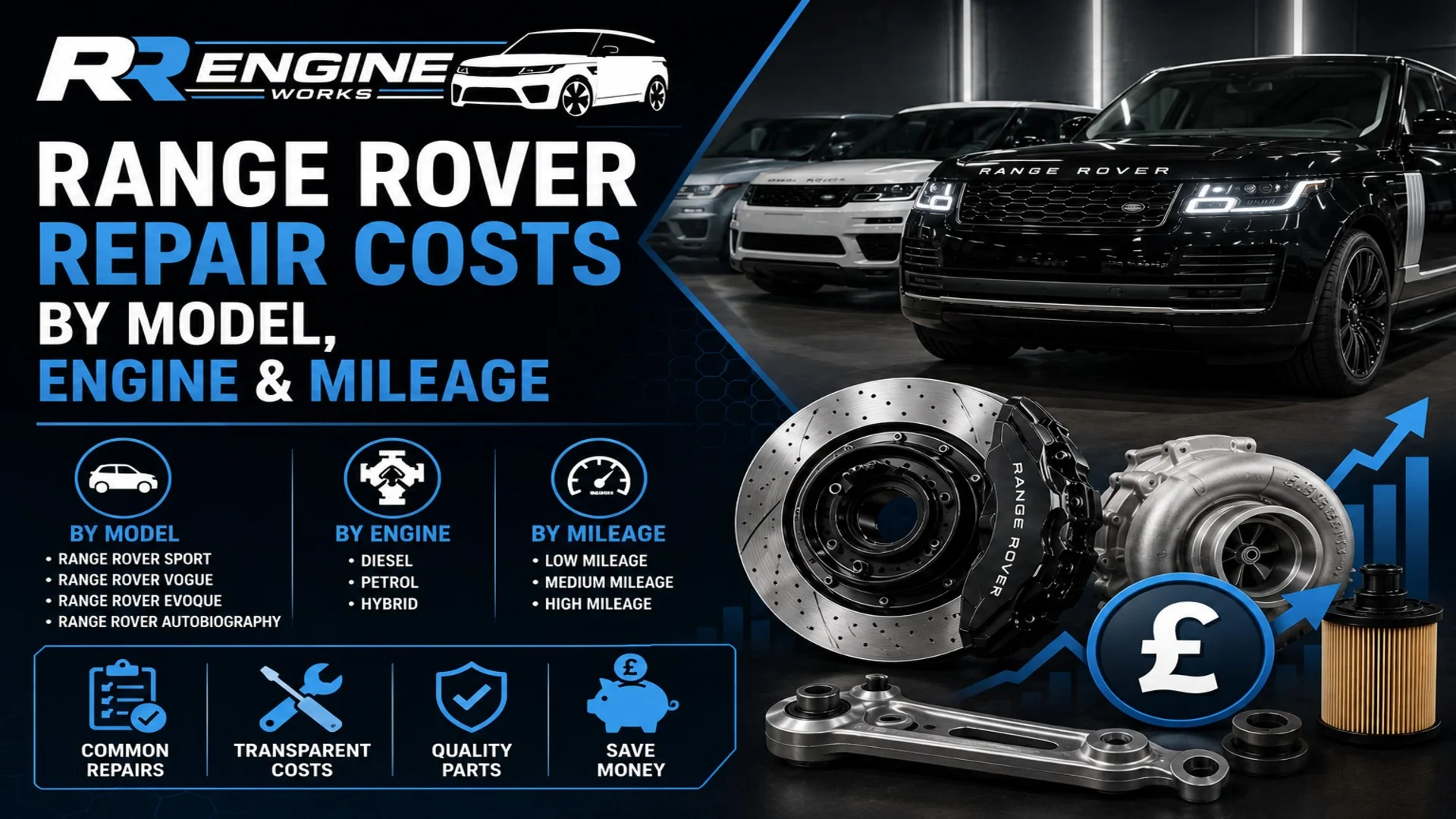
Not all Range Rovers are created equal when it comes to repair bills. A Range Rover Evoque and a full-size Range Rover Vogue with a 5.0 V8 live in very different cost brackets, and even within the same model, the engine variant and mileage change the picture significantly.
Repair Costs by Model
Model | Common Repair Focus | Typical Cost Range |
| Range Rover Evoque | Timing chain, differential, electrical | £300–£2,500 |
| Range Rover Velar | Air suspension, infotainment faults | £400–£2,800 |
| Range Rover Sport | Air suspension, turbo, gearbox | £500–£4,000 |
| Range Rover Vogue (full-size) | Air suspension, engine, transmission | £600–£5,000+ |
| Range Rover SVR | Supercharged engine, brakes, suspension | £800–£6,000+ |
| L322 / L405 / L460 | Varies by generation and mileage | £500–£7,000+ |
The full-size Vogue and SVR sit at the top of the cost scale largely because of engine complexity and premium parts pricing. The Evoque, being the smallest and mechanically simpler platform, tends to be the most affordable to keep on the road.
Repair Costs by Engine
The engine under the bonnet matters as much as the model badge:
- Ingenium (2.0 petrol/diesel): generally more affordable to repair, though early units had known timing chain issues.
- TDV6 / SDV6 (3.0 diesel): solid but prone to timing chain and EGR/DPF problems as mileage climbs.
- TDV8 / SDV8 (4.4 diesel): more complex, higher parts and labour cost on major work.
- 5.0 V8 (naturally aspirated and supercharged): the most expensive to repair, specialist labour, premium parts, and higher-value components throughout.
How Mileage Affects Repair Costs (Under 50k to 150k+ Miles)
Mileage is one of the strongest predictors of what you'll spend over a year of ownership:
- Under 50,000 miles: mostly wear items, brakes, tyres, minor servicing.
- 50,000–80,000 miles: first major components start to age, air suspension, water pumps, sensors.
- 80,000–120,000 miles: timing chains, turbos, and gearbox components enter their higher-risk window.
- 120,000–150,000 miles: multiple ageing systems can fail close together, increasing the chance of compound repair bills.
- 150,000+ miles: engine and transmission overhaul or replacement becomes a realistic consideration.
Common Faults by Age & Service History
A Range Rover with full main dealer or specialist service history, on schedule, tends to develop faults later and more predictably than one with gaps in its service record. Missed oil changes accelerate timing chain wear; skipped suspension checks let small air leaks turn into compressor failures. If you're buying used, service history isn't just paperwork, it's a genuine predictor of your future repair bill.
Common Range Rover Repairs and What They Cost
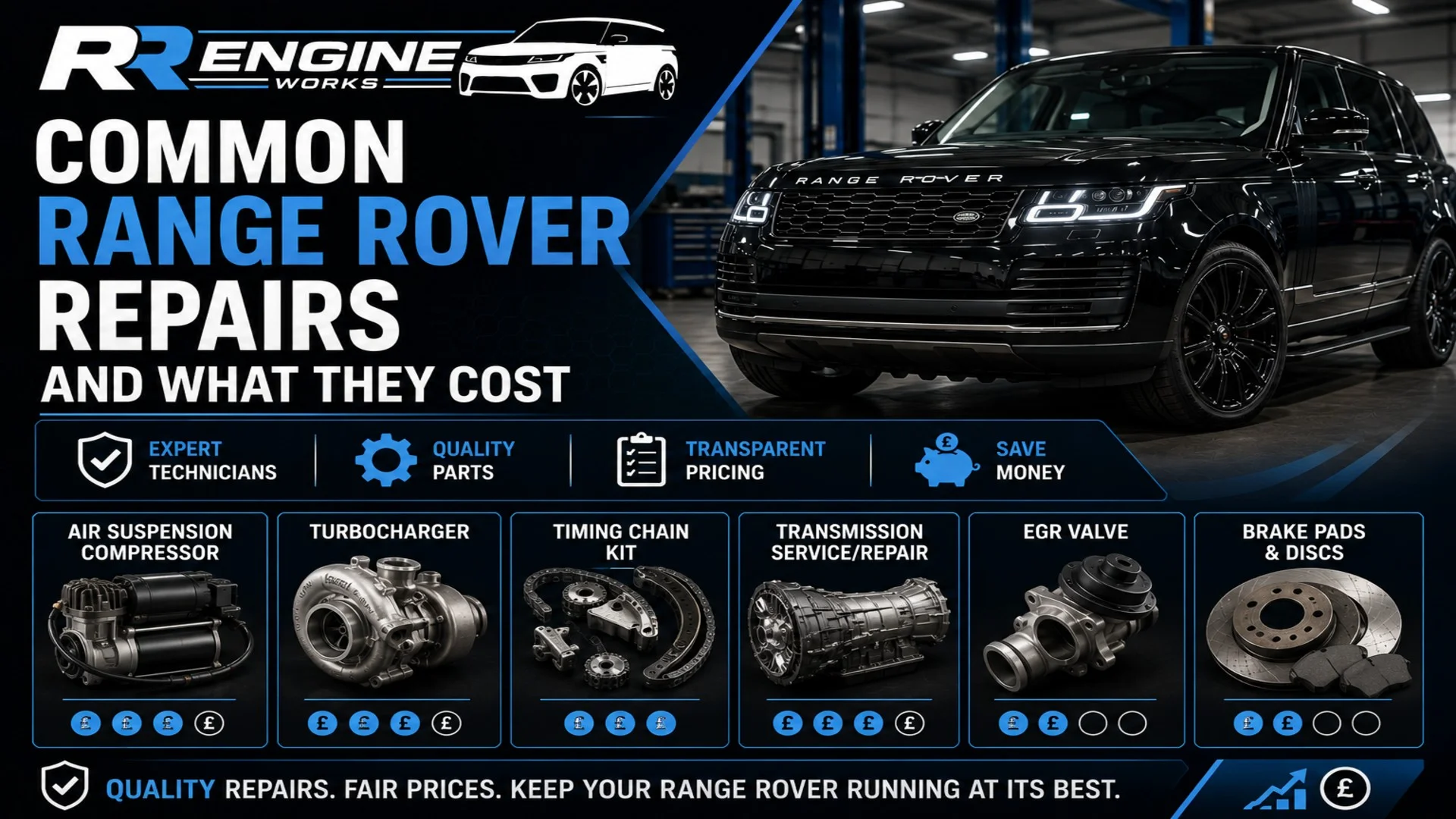
This is where most searches land: real component-level pricing. Below are the repairs that come up again and again in specialist workshops.
Air Suspension Repair Cost (Compressor, Air Spring, Valve Block)
Air suspension is the single most common expensive fault on a Range Rover. The system relies on an air compressor, individual air springs at each corner, a valve block, and height sensors, any one of which can fail independently.
- Air spring replacement (single corner): £350–£700
- Compressor replacement: £500–£900
- Valve block replacement: £400–£800
- Full system overhaul (multiple components): £1,200–£1,800+
Symptoms include a car that sits noticeably lower on one corner overnight, a suspension warning light, or a compressor that runs constantly and won't stop cycling.
Engine Repair Cost (Timing Chain, Turbo, EGR, DPF, Head Gasket)
Engine-related faults span a wide cost range depending on what's failed:
- Timing chain and tensioner replacement: £1,500–£3,500
- Turbocharger replacement: £1,200–£2,800
- EGR valve replacement: £350–£700
- DPF cleaning: £150–£300 | DPF replacement: £900–£1,800
- Head gasket repair: £1,200–£2,500
A rattling noise on cold start-up is one of the classic early signs of timing chain wear on the TDV6 and early Ingenium engines, worth getting checked before it becomes a catastrophic failure.
Gearbox & Transmission Repair Cost (Transfer Case, Differential)
- Automatic gearbox service: £250–£450
- Gearbox repair (partial): £1,200–£2,500
- Gearbox replacement: £2,500–£4,500
- Transfer case repair: £800–£1,800
- Differential repair: £600–£1,500
Delayed or jerky gear changes, especially from cold, are often the first warning sign, and catching it early is almost always cheaper than waiting for full failure.
Brakes, Electrical & Diagnostic Costs
- Brake pads (per axle): £150–£350
- Brake discs and pads combined: £350–£700
- Battery replacement: £200–£400
- Alternator replacement: £350–£650
- Starter motor replacement: £300–£550
- Electrical fault diagnosis: £80–£200 (can rise with complex intermittent faults)
Engine Rebuild vs Engine Replacement Cost Comparison
When engine damage is severe, owners typically face a choice between a rebuild and a full replacement.
Factor | Engine Rebuild | Engine Replacement |
| Typical cost | £4,000–£7,500 | £5,500–£9,500+ |
| Time required | Longer (custom work) | Often faster if a unit is in stock |
| Best for | Engines with isolated internal damage | Engines with widespread or unknown damage |
| Warranty | Varies by specialist | Often stronger if using a reconditioned unit |
A rebuild makes sense when the damage is contained, say, a single bearing or piston issue, and the block itself is sound. A full replacement is usually the safer call when there's uncertainty about the extent of the damage, or when the vehicle's mileage means other engine components are likely close to failure too.
Dealer vs Independent Specialist, and How to Reduce Your Repair Bill
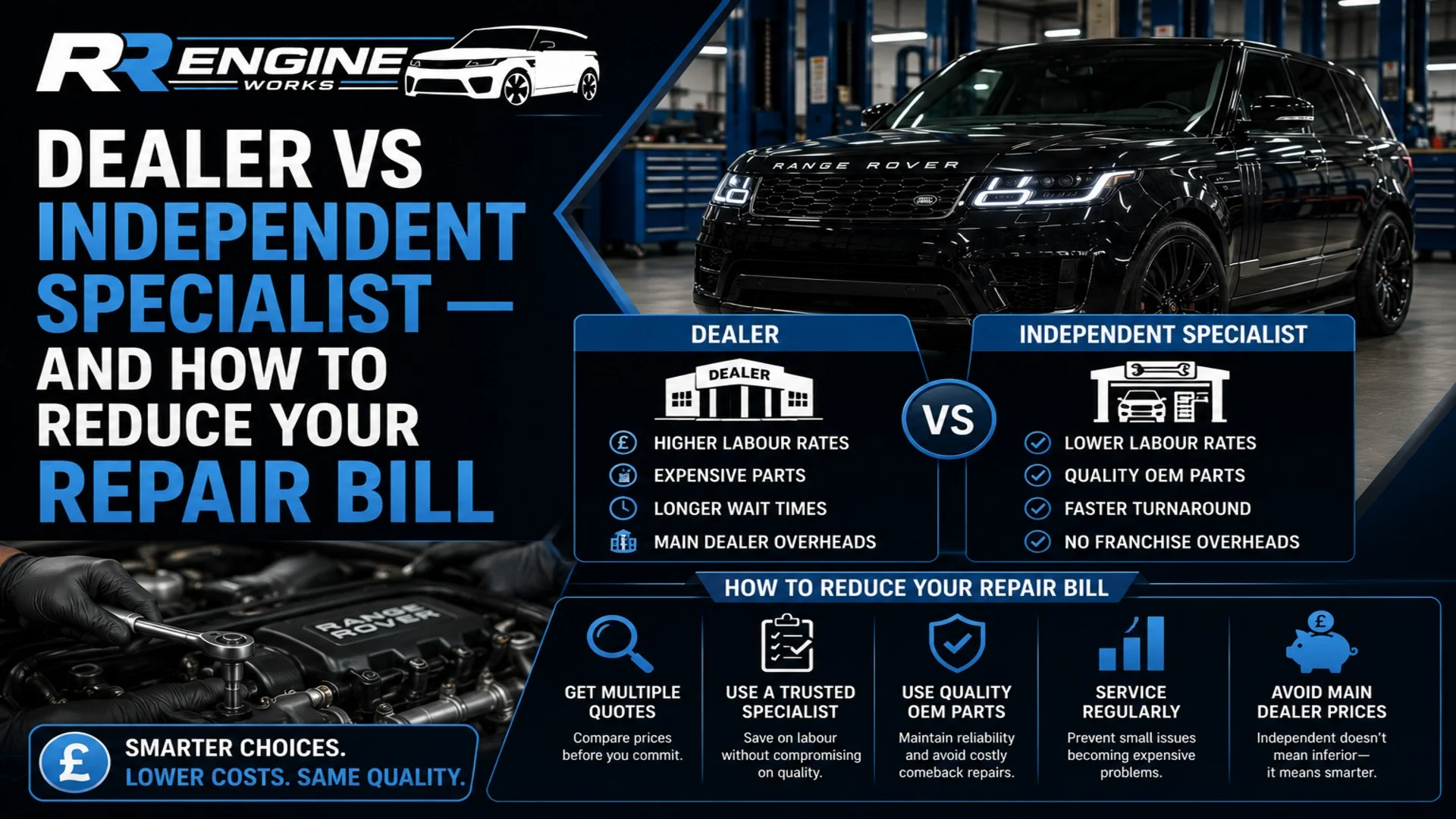
This is arguably the single biggest lever you have over your final bill. The gap between a main dealer and an independent Range Rover specialist can be enormous, and it's rarely about quality.
Main Dealer vs Independent Range Rover Specialist Pricing
Factor | Main Dealer | Independent Specialist |
| Labour rate | £120–£180/hr | £70–£110/hr |
| Parts | Genuine only, full retail price | Genuine, OEM, or quality aftermarket |
| Diagnostic tools | Full JLR system access | Specialist-grade diagnostic tools (often equally capable) |
| Turnaround | Can involve longer waits | Often quicker, more flexible |
| Warranty | Manufacturer-backed | Specialist-backed, varies by garage |
| Best for | Vehicles under manufacturer warranty | Out-of-warranty vehicles, most repairs |
For a car still under factory warranty, the dealer route protects that warranty. Once the warranty's expired, a genuine Range Rover specialist, one with the right diagnostic software and real experience on these vehicles, will typically do the same job for considerably less, without cutting corners.
Genuine vs OEM vs Aftermarket vs Reconditioned Parts
- Genuine parts: made or approved directly by Jaguar Land Rover, highest cost, guaranteed fit.
- OEM parts: made by the same suppliers who manufacture parts for JLR, sold under a different brand, near-identical quality, lower price.
- Aftermarket parts: third-party manufactured, cost varies widely in quality, so it pays to ask your specialist which brands they trust.
- Reconditioned parts: rebuilt to working order, often used for gearboxes, engines, and compressors, a strong middle-ground on major components.
For safety-critical parts like brakes and suspension, genuine or high-grade OEM is usually worth the extra spend. For less critical components, reconditioned or trusted aftermarket parts can save real money without compromising reliability.
Should You Repair or Replace Your Range Rover?
This is the question worth sitting with before committing to a major repair. Weigh it against:
- Current vehicle value versus the repair estimate
- Mileage and how many other components are likely nearing the end of their life
- Service history, consistent history suggests fewer hidden problems
- Engine and gearbox condition, not just the fault currently in front of you
- MOT history for recurring advisories
- Future repair risk, one fixed fault doesn't mean the next one isn't close behind
As a rough rule of thumb: if a single repair estimate approaches 50% or more of the car's current market value, it's worth getting a full pre-repair inspection before deciding, rather than assuming the repair is automatically the right call.
5 Ways to Cut Your Range Rover Repair Costs
- Use a genuine Range Rover specialist rather than a general garage, right tools, right experience, first time.
- Get multiple independent quotes before committing to major work.
- Ask about OEM or reconditioned parts where safety isn't compromised.
- Stick to service intervals, most expensive failures start as small, cheap-to-fix issues.
- Get a proper diagnostic before authorising repairs, never let a garage guess.
Get a Free, No-Obligation Repair Quote
If you're dealing with a fault right now and want a straight answer on cost before you commit to anything, RR Engine Works specialises in exactly this, Range Rover engine, gearbox, and suspension diagnostics and repair, based at Unit 1 Hedley Ave, Grays RM20 4EL. Get in touch for a free, no-obligation quote before you book anywhere else.
Range Rover Repair Cost FAQs
How much does it cost to repair a Range Rover?
Costs typically range from £80 for a diagnostic check up to £9,000+ for a full engine replacement. Most owners deal with repairs in the £300–£2,000 range for common faults like brakes, suspension, or electrical issues.
Are Range Rovers expensive to maintain?
Compared to mainstream SUVs, yes, largely due to air suspension systems, complex electronics, and specialist parts pricing. Regular servicing significantly reduces the risk of expensive surprise failures.
Is it cheaper to use an independent Range Rover specialist than a main dealer?
Generally, yes. Independent specialists typically charge £70–£110 per hour compared to £120–£180 at a main dealer, often with comparable diagnostic capability once the vehicle is out of manufacturer warranty.
What is the most expensive Range Rover repair?
Engine replacement and full transmission replacement sit at the top of the cost scale, typically £5,500–£9,500+ and £2,500–£4,500 respectively.
What is the most common Range Rover repair?
Air suspension faults are among the most frequently reported issues, followed by electrical faults and timing chain wear on older diesel engines.
Is my Range Rover worth repairing?
It depends on the repair cost relative to the car's value, its mileage, and its service history. A full inspection before committing to major work is the safest way to decide.
Final Word
A Range Rover is worth the investment, but only if you go into repairs with your eyes open. Knowing the typical cost tiers, understanding what drives your specific model and engine's repair profile, and choosing the right specialist over the wrong dealer are the three things that separate owners who manage their running costs well from those who get caught out.
If you're facing a repair right now and want an honest, itemised quote, not a guess, get in touch with RR Engine Works at Unit 1 Hedley Ave, Grays RM20 4EL for a free, no-obligation assessment before you book anywhere else.