

If your Land Rover has started throwing up an "Exhaust Filter Full" warning, sitting in limp mode on the motorway, or you've noticed the oil level creeping up on the dipstick, you're not imagining things, and you're far from alone. Ingenium DPF regeneration problems are one of the most common reasons Land Rover and Range Rover owners end up searching for answers at 11pm after a warning light ruins their evening commute.
The good news is that most of these faults follow a predictable pattern once you understand how the 2.0-litre Ingenium diesel handles regeneration. The less good news is that ignoring the warning rarely makes it go away, it usually gets more expensive. This guide walks through exactly why Ingenium DPF regeneration fails, what the warning messages actually mean, how the fault is diagnosed properly, and what it costs to put right.
Why Is My Land Rover Ingenium DPF Not Regenerating Properly?
Before troubleshooting a fault, it helps to understand what the DPF is actually doing, because most regeneration problems trace back to the same root cause: the process getting interrupted before it finishes.
How Does Ingenium DPF Regeneration Actually Work?
The diesel particulate filter sits in the exhaust system and traps soot produced by combustion. Over time, that soot builds up inside the filter. The engine control unit (ECU) constantly monitors soot loading using differential pressure and exhaust temperature sensors, and when the filter reaches a certain threshold, it triggers active regeneration.
During active regeneration, the ECU uses post-injection, extra fuel injected later in the combustion cycle, to raise exhaust gas temperature high enough to burn off the trapped soot. This is different from passive regeneration, which happens naturally during sustained high-speed driving without any ECU intervention at all.
The problem is that active regeneration needs roughly 20–30 minutes of consistent, elevated exhaust temperature to complete. That's where most Ingenium diesels start running into trouble.
Why Does My Ingenium DPF Keep Blocking After a Service?
It's a common complaint: the car has just had a service, and within weeks the DPF warning is back. This usually isn't a sign that the service was done incorrectly, it's more often a sign that regeneration is being started but never finishing.
A regeneration cycle that gets interrupted doesn't reset the soot load; it just leaves the filter partially cleaned and the ECU still counting toward the next attempt. Repeat that cycle enough times and the DPF's baseline soot loading climbs steadily, even between services.
Can Short Journeys Really Cause DPF Regeneration Failure?
Yes, and this is the single biggest cause of Ingenium DPF regeneration problems we see at RR Engine Works. Short, low-speed journeys, particularly around Grays and similar urban routes, simply don't generate enough sustained exhaust temperature for regeneration to complete.
How Stop-Start Driving Stops Regeneration From Completing
When you're braking at junctions, idling in traffic, or covering short school-run distances, exhaust temperature drops every time the car slows down. Regeneration needs a continuous window of higher revs and steady load, something a 10-minute drive to the shops rarely provides. The ECU starts the process, temperature falls before it finishes, and the cycle aborts partway through.
Why Does My Ingenium DPF Keep Regenerating Too Often?
If regeneration seems to be kicking in every single journey, that's usually a sign the soot load is already high and the ECU is trying to catch up. It can also point to a faulty differential pressure sensor giving the ECU an inaccurate reading, or an EGR fault causing extra soot production in the first place. Frequent regeneration attempts that never fully resolve are a strong early warning sign, worth investigating before the filter reaches critical blockage.
What Are the Symptoms of a Blocked Ingenium DPF?
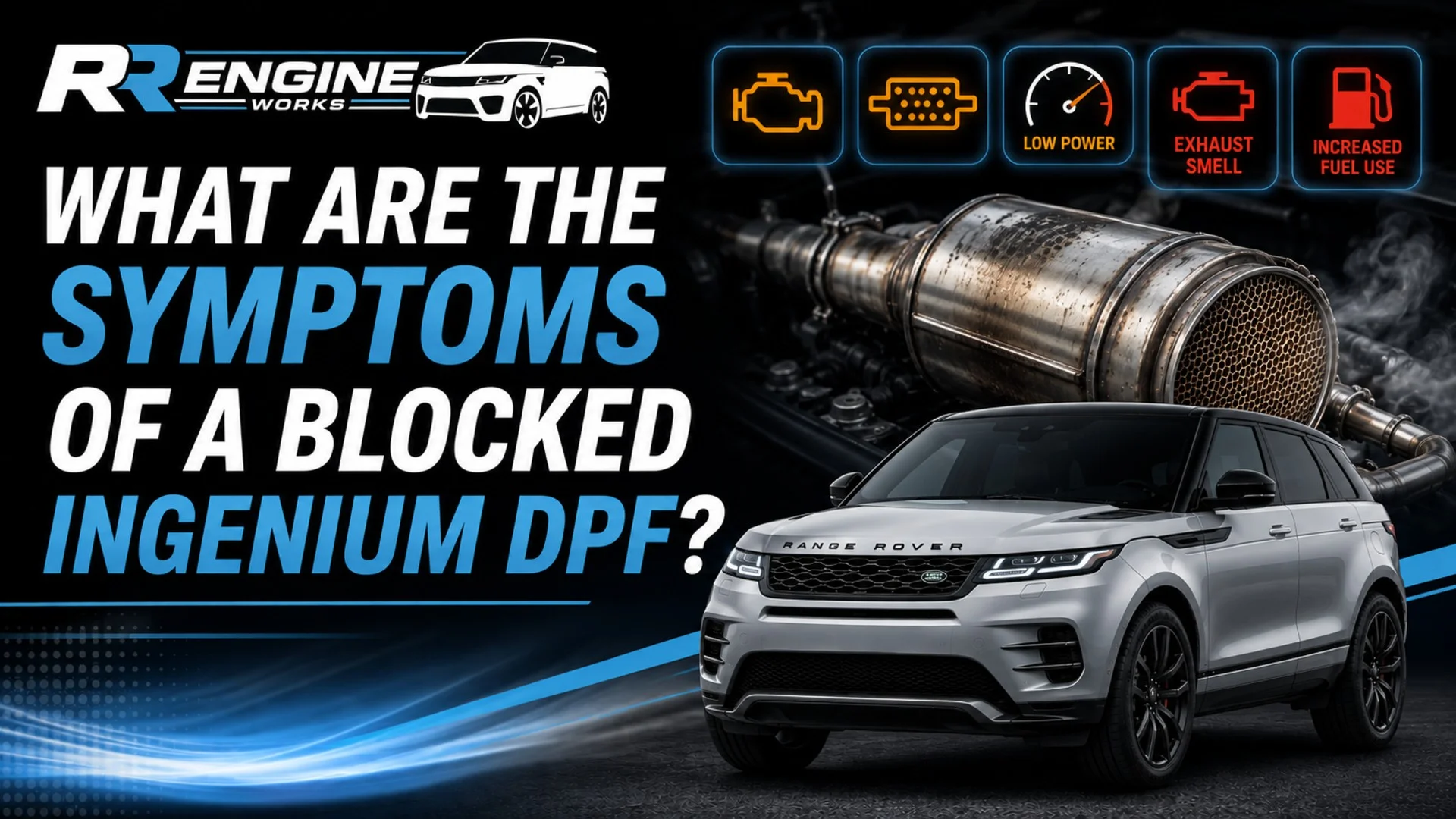
Recognising the symptoms early can be the difference between a straightforward cleaning job and a full DPF replacement. Here's what to watch for.
What Does "Exhaust Filter Nearly Full" Mean on My Land Rover?
This is an early-stage warning. It means the ECU has detected soot loading approaching its threshold and is asking you to complete a regeneration drive, typically 20+ minutes at motorway speed or above 2,000rpm. At this stage, the fix is often as simple as a sustained drive, and no specialist intervention is needed yet.
What Does "Exhaust Filter Full – Visit Dealer" Mean?
This is more serious. It means multiple regeneration attempts have failed and the ECU has essentially given up trying to fix it automatically. At this point, driving alone usually won't clear the fault, the car needs a forced regeneration using manufacturer-level diagnostic equipment, or in more advanced cases, physical cleaning or replacement of the filter.
Can a Blocked DPF Cause Limp Mode or Loss of Power?
Yes. As the DPF becomes increasingly restricted, exhaust back pressure rises. The ECU responds by limiting engine power to protect the turbocharger and exhaust system, this is limp mode. Owners typically describe it as the car suddenly feeling sluggish, refusing to rev past a certain point, or losing power noticeably on inclines or when overtaking.
Is My Rising Oil Level Linked to Failed DPF Regeneration?
This is one of the most under-explained symptoms, and one of the most important. When post-injection fuel is used repeatedly to try (and fail) to trigger regeneration, some of that unburned diesel can wash past the piston rings and end up in the sump. This is called oil dilution, and it's a direct consequence of interrupted regeneration cycles, particularly common in Ingenium engines used mainly for short trips.
Why Does My Engine Oil Smell of Diesel?
If you check your dipstick and the oil smells strongly of fuel rather than the usual engine oil smell, that's diesel contamination, a fairly reliable sign that regeneration attempts have been failing repeatedly rather than completing normally.
How Oil Dilution Affects the Turbo and Timing Chain
Diluted oil has reduced viscosity, which means it can't lubricate properly under load. This matters most for two components:
- The turbocharger, which relies on properly pressurised, correctly viscous oil to protect its bearings at very high rotational speeds. Oil dilution accelerates bearing wear and can lead to turbo failure.
- The timing chain and tensioners, which depend on consistent oil pressure to maintain correct chain tension. Poor lubrication here is a known contributor to Ingenium timing chain wear and, in worst cases, chain failure.
In other words: a DPF warning you've been putting off can end up costing considerably more than the DPF itself if it's left to affect the oil and, downstream, the turbo and timing chain.
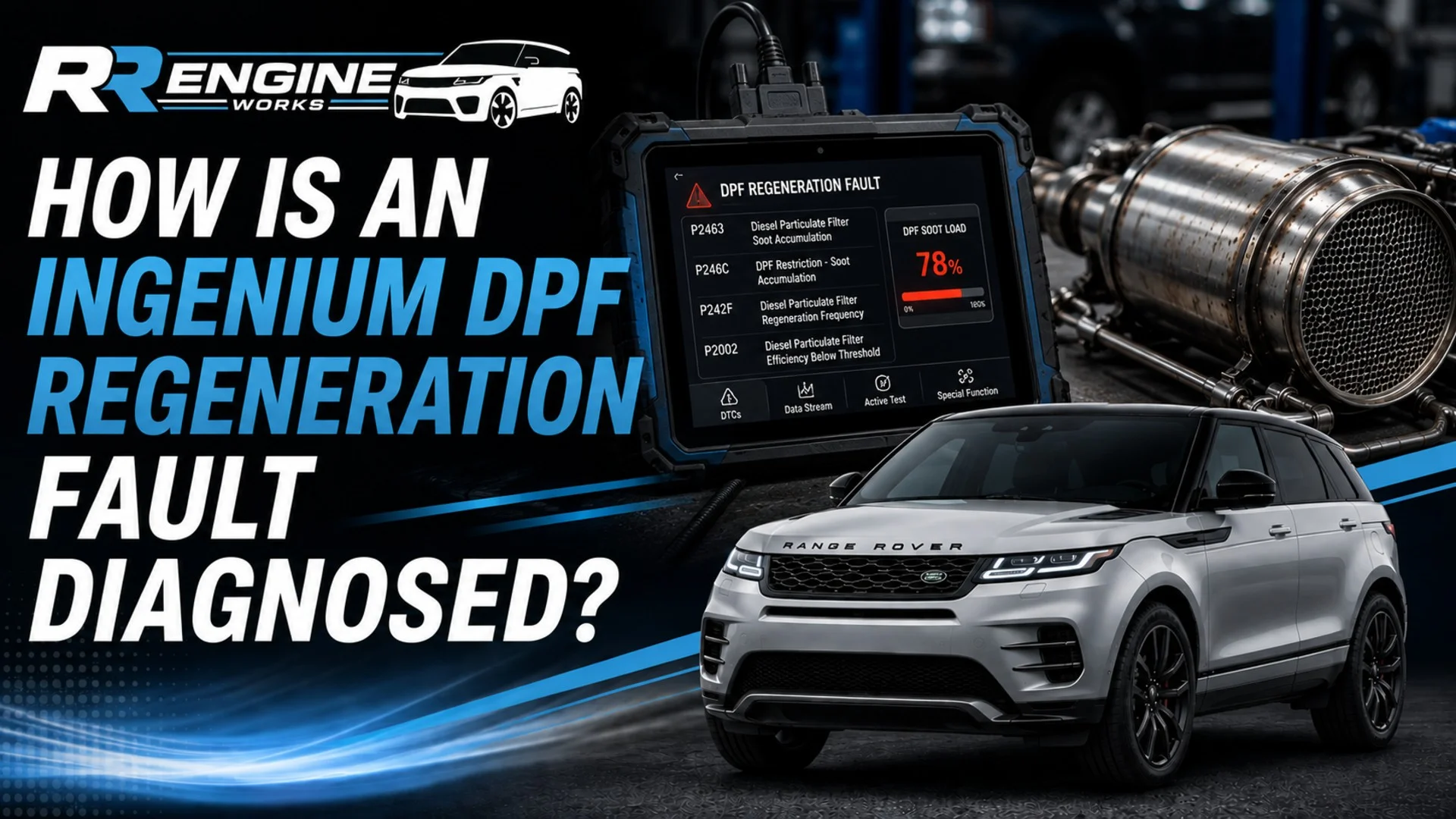
How Is an Ingenium DPF Regeneration Fault Diagnosed?
Not every DPF warning means the filter itself needs replacing. A proper diagnosis looks at the whole system, not just the symptom.
What Fault Codes Indicate a DPF Regeneration Problem?
Manufacturer-level diagnostic scanning on Ingenium engines will typically pull one or more of the following codes when a regeneration fault is present:
Fault Code | What It Typically Relates To |
| P2002 | DPF efficiency below threshold |
| P2003 | DPF efficiency below threshold (bank/cylinder specific) |
| P242F | DPF restriction, often linked to ash accumulation |
| P2459 | DPF regeneration frequency, too frequent or incomplete |
| P2463 | Excessive soot accumulation |
| P244A | Differential pressure or temperature-related fault |
It's worth noting these codes point toward the area of the fault rather than confirming a single fix. A P2463 code, for example, could mean genuinely excessive soot, or it could mean a faulty pressure sensor is reporting soot that isn't really there. That distinction matters, because replacing a DPF unnecessarily is an expensive mistake.
Soot vs Ash, Why the Difference Matters
Soot is combustible and can generally be burned off during a normal or forced regeneration. Ash, on the other hand, is a non-combustible by-product that accumulates gradually over the engine's life and cannot be removed by regeneration at all. A DPF loaded mainly with soot can often be recovered through cleaning or forced regeneration. One with heavy ash accumulation may need professional cleaning or replacement regardless of how many regeneration cycles you run.
How Do We Diagnose Ingenium DPF Faults at RR Engine Works?
At RR Engine Works, we don't start with "replace the DPF" as the default answer, because in a lot of cases it isn't the right one. Our diagnostic process typically includes:
- Full fault code scan using manufacturer-level diagnostic software
- Live soot load and differential pressure readings, not just stored codes
- Exhaust temperature sensor and pressure sensor testing
- Engine oil inspection for signs of fuel dilution
- A check of related systems, EGR, injectors, and airflow, that can cause repeat regeneration failure even after the DPF itself is cleared
This is the step most generic garages skip, and it's usually why owners end up back at square one a few months after a "fix."
How Is a Blocked Ingenium DPF Fixed? (Cost & Booking)

Once we know exactly what's causing the fault, the repair path usually falls into one of a few categories, from a simple drive to a full replacement.
Can You Force Regenerate an Ingenium DPF?
Yes. A forced or service regeneration uses diagnostic equipment to trigger regeneration directly, rather than waiting for the right driving conditions. This is typically done alongside a DPF adaptation reset, so the ECU's learned values reflect the filter's actual current condition rather than carrying forward inaccurate soot load estimates. Forced regeneration is often effective where the DPF is soot-loaded but not yet physically damaged.
DPF Cleaning vs Replacement, Which Do I Need?
This is one of the most common questions we're asked, and the honest answer depends entirely on the diagnostic findings.
Option | Best Suited For | What It Involves |
| Forced/service regeneration | Soot-loaded DPF, early-stage warnings | ECU-triggered regeneration plus adaptation reset |
| Professional DPF cleaning | Heavier soot or moderate ash buildup | Physical removal of deposits from the filter |
| DPF replacement | Cracked, damaged, or heavily ash-laden filters | Fitting a new or reconditioned filter |
Cleaning is generally the more cost-effective route when the filter itself is structurally sound, which is why a proper diagnosis before any work starts matters so much, it's the difference between a moderate repair bill and a full replacement.
How Much Does Ingenium DPF Cleaning or Replacement Cost?
Costs vary depending on the extent of the blockage, whether sensors also need replacing, and whether the filter itself is salvageable. As a general guide:
- Forced regeneration and adaptation reset is the lowest-cost option, suited to early warnings
- Professional DPF cleaning sits in the mid-range and is often the most cost-effective fix for a moderately blocked filter
- Full DPF replacement is the highest cost, typically only necessary where the filter is physically damaged or too ash-laden to recover
Because pricing depends on your specific vehicle and the diagnostic results, we'd always recommend a proper scan before assuming replacement is the only option, get in touch with our team for an accurate quote based on your Discovery Sport, Evoque, Velar, Defender, or Range Rover Sport.
Book an Ingenium DPF Regeneration Repair Near Grays, Essex
If your Land Rover is showing an exhaust filter warning, has gone into limp mode, or you've noticed the oil level rising, it's worth having it looked at before the fault progresses further. RR Engine Works is based at Unit 1 Hedley Ave, Grays, RM20 4EL, and we work on Ingenium diesel engines across the full Land Rover and Range Rover range, as well as Jaguar's E-Pace, F-Pace, XE and XF models sharing the same engine family.
Frequently Asked Questions
Can I drive with a DPF warning light on? You can drive short-term with an early "exhaust filter nearly full" warning, and in fact a sustained motorway drive may clear it. Once you see "exhaust filter full – visit dealer" or the car enters limp mode, continued driving risks worsening the blockage and increasing repair costs, it's best booked in at that point.
Why is my DPF clogging up even if I've recently serviced the car? A service doesn't change your driving pattern. If most of your journeys are short and low-speed, the DPF can still struggle to complete regeneration regardless of how recently it was serviced. This is a driving-conditions issue as much as a mechanical one.
Can I clean or remove the DPF myself? DPF removal is illegal for road use in the UK and will fail an MOT. Cleaning should be done professionally using the correct process and equipment, DIY cleaning products rarely reach deep enough into the filter to resolve heavier blockages.
What can I do to prevent DPF regeneration problems? Where possible, build in a longer, steady-speed drive at least once a week, 20 to 30 minutes at motorway speed is usually enough to let regeneration complete naturally. Keeping up with servicing, using the correct oil grade, and addressing any warning light promptly rather than waiting all help reduce the risk of repeat failures.
Can DPF regeneration problems damage the turbo or timing chain? Yes, indirectly. Repeated failed regeneration attempts can lead to oil dilution, which reduces lubrication quality. Since both the turbo and timing chain depend on properly pressurised, correctly viscous oil, prolonged dilution increases wear on both components over time.
Getting It Fixed Properly
Ingenium DPF regeneration problems rarely fix themselves, and the longer a warning sits ignored, the more likely it is to drag other components, oil condition, the turbo, the timing chain, into the problem with it. The upside is that most cases, caught early, are entirely manageable without needing a full replacement.
If your Land Rover or Range Rover is showing signs of a blocked DPF, get it properly diagnosed rather than guessing. Contact RR Engine Works in Grays to book a diagnostic scan and find out exactly what's going on before it turns into a bigger repair bill.